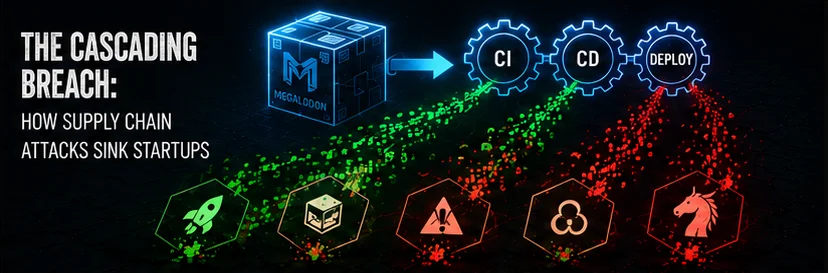
Supply Chain Security • MAY 25, 2026
The NPM Breach frenzy: Why Open Source can cripple your organization?
For startups, speed is everything. The race to achieve product-market fit often requires leveraging open-source software (OSS) and automated CI/CD pipelines to deploy code faster than the competition. But this reliance on external code and automated trust models has created a critical vulnerability. In May 2026, the global startup ecosystem experienced this vulnerability firsthand through a devastating software supply chain attack.
The incidents, often referred to as the “TanStack Cascade” and the “Megalodon Push,” demonstrated a frightening new reality: threat actors no longer need to target your company directly if they can compromise the software you trust.
The Attack Mechanism: Poisoning the Well
The attack wasn’t a breach of a specific startup’s network. Instead, sophisticated actors identified vulnerabilities in highly popular, trusted open-source packages—including components of the widely used TanStack developer ecosystem. They successfully injected malicious code into update packages of these libraries.
When developers globally ran standard update commands or when automated CI/CD pipelines pulled the “latest” version of these trusted dependencies, they unknowingly integrated malware directly into their applications. This malware was designed to be stealthy, specifically targeting the exfiltration of sensitive environment variables, cloud access tokens (like AWS keys and SaaS API credentials), and source code from the developers’ local machines and the build servers.
Because startups are massive consumers of OSS and often deploy code dozens of times a day, the malware spread through the ecosystem like wildfire. A single corrupted package cascaded down, potentially compromising thousands of downstream companies in matter of hours.
Visualizing the Hidden Complexity
The scale of these breaches highlights the invisible “dependency debt” startups accumulate. Your application is not just the code you wrote; it is a complex, towering tree built upon hundreds, sometimes thousands, of nested, external libraries.
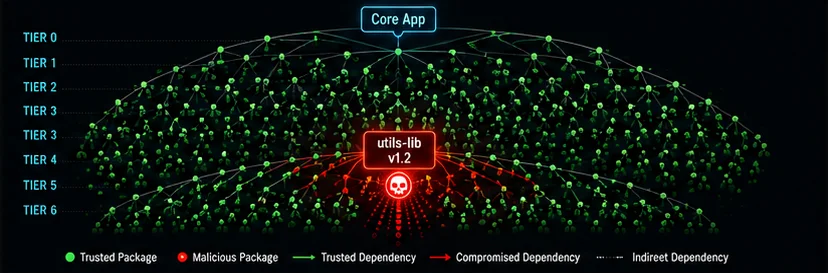
When we visualize this dependency tree, it usually looks green and healthy—a robust network of trusted packages supporting your application. But the TanStack incident showed how easily a single node near the root of that tree can turn red and toxic. If a fundamental, deeply nested library like ‘utils-lib v1.2’ is corrupted, that infection flows upward, compromising every framework and application built upon it. The complexity is the vulnerability.
Why Startups Are the Perfect Target
Startups are disproportionately impacted by supply chain attacks for two reasons: dependency and integration.
OSS Reliance: Startups often build MVP (Minimum Viable Product) apps that are up to 90% open-source code. They simply don’t have the resources to write everything from scratch.
SaaS Sprawl: Startups utilize a massive array of third-party SaaS tools—Stripe for payments, Twilio for communications, OpenAI for AI, Segment for data. The credentials to access all of these high-value systems live in the application’s environment variables. Stealing these tokens is the ultimate prize for attackers. By compromising the package, they gain a master key to the startup’s entire integrated SaaS stack.
Actionable Advice for Startups
The era of blindly trusting npm install is over. Startups must modernize their software supply chain security.
Pin Your Dependencies: Never allow automated systems to pull ‘latest’ or use wildcard versions (e.g., ^1.2.0). Strictly pin versions (e.g., 1.2.5) to prevent automated upgrades to malicious versions.
Audit Your Dependency Tree: Regularly use auditing tools to map your full nested dependency list and screen for known vulnerabilities. Treat new dependencies with extreme caution.
Secure Your Build Pipeline: Harden your CI/CD environments. Use short-lived, scoped credentials for deployments and monitor build servers for anomalous outbound network traffic. A corrupted build is your most significant risk.
Speed is vital, but security cannot be sacrificed. A single, unseen dependency should not have the power to sink your startup.