Ransomware Trends • JUN 01, 2026
The Death of the Encryptor? The Rise of Pure-Extortion Campaigns
For years, the defining characteristic of a ransomware attack was the encryptor payload. The terrifying red screen locking users out of their workstations and the complete operational paralysis of the business were the hallmarks of a successful breach.
But as we analyze the threat landscape through the first half of 2026, a massive tactical shift has solidified: the most sophisticated threat groups are abandoning the encryptor entirely. Welcome to the era of pure-extortion.
Recent intelligence indicates that up to 50% of attacks currently tracked under the “ransomware” umbrella no longer involve file encryption. Instead, adversaries are focusing purely on data theft, followed by aggressive, multi-layered extortion tactics to force a payout.
Why Drop the Ransomware?
The shift away from encryption isn’t happening because encryptors stopped working; it’s happening because the business model of cybercrime is evolving toward maximum efficiency and minimal friction.
Deploying an encryptor across an enterprise network is loud, technically complex, and time-consuming. It triggers EDR (Endpoint Detection and Response) alerts, alerts human defenders immediately, and draws intense scrutiny from federal law enforcement and incident response firms. Furthermore, organizations have spent the last five years heavily investing in immutable backups and disaster recovery. If a company can restore its operations from a backup in 24 hours, the encryptor loses its leverage.
By skipping the encryption phase, attackers achieve three massive advantages:
Stealth and Dwell Time: Without the noisy encryption process, attackers can move laterally and exfiltrate terabytes of highly sensitive data slowly, staying undetected in the environment for months rather than days.
Bypassing the Backup Defense: It does not matter how perfect your disaster recovery plan is if your data isn’t locked, but rather held hostage on the dark web. Backups cannot prevent a data leak.
Lower Operational Overhead: Developing, updating, and deploying custom encryptors that evade modern antivirus requires high-level malware engineering. Pure data theft requires only initial access and standard, often legitimate, administrative tools (Living off the Land) to copy files to cloud storage.
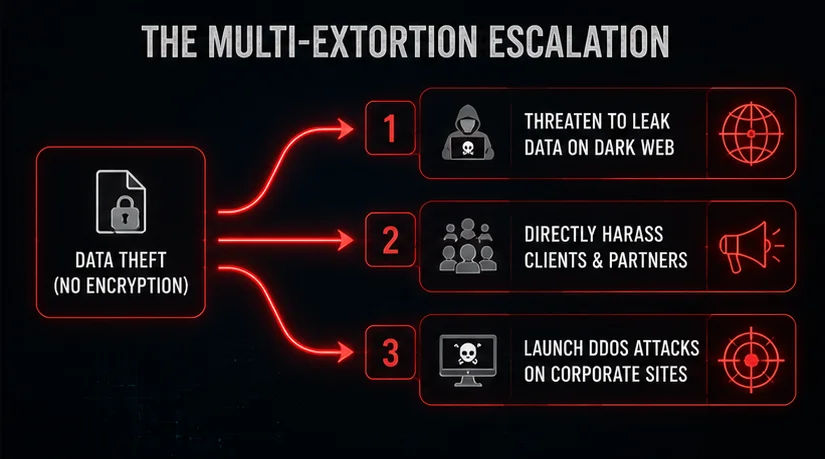
The Multi-Extortion Escalation
Without the immediate pain of operational downtime, threat actors have escalated their pressure tactics to force victims to the negotiation table. We are now routinely witnessing triple and quadruple extortion scenarios:
Double Extortion: “Pay us, or we leak your proprietary source code, customer databases, and internal emails on our dark web blog.”
Triple Extortion: The attackers bypass the company entirely and directly email clients, patients, or partners whose data was caught in the breach, urging them to sue or pressure the victim organization into paying.
Quadruple Extortion: Launching simultaneous Distributed Denial of Service (DDoS) attacks against the victim’s public-facing infrastructure to create public panic and executive chaos while the extortion demands are being made.
Defending Against the Unseen Threat
The death of the encryptor means that traditional ransomware defense strategies are largely obsolete. If your primary defense is your backup strategy, you are highly vulnerable.
Security teams must shift their focus from recovery to prevention of exfiltration. This means deploying robust Data Loss Prevention (DLP) tools, tightly restricting outbound data flows, and aggressively hunting for anomalous, large-scale data transfers to unknown cloud storage providers. In 2026, if the data leaves the building, the battle is already lost.